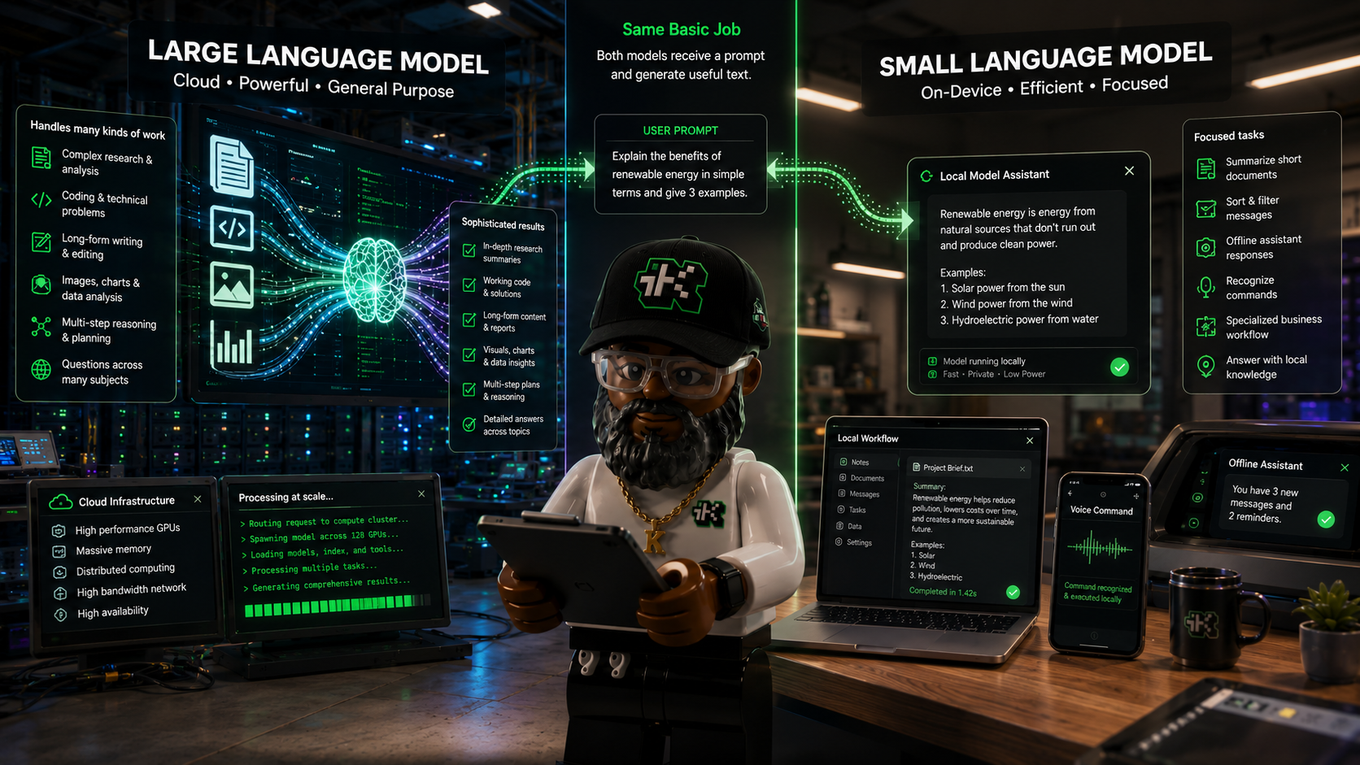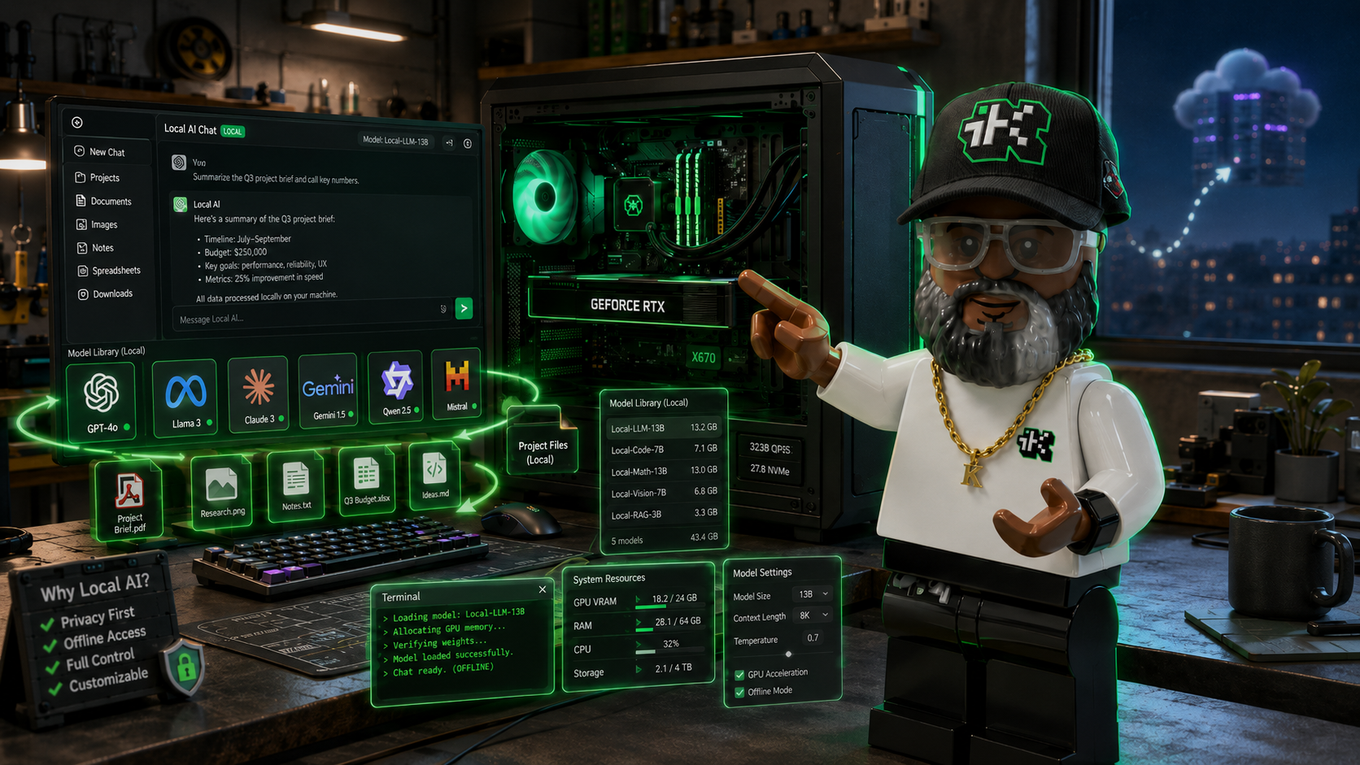

An open AI model publishes its weights: the billions of numbers a model adjusts during training that store everything it learned, saved as one downloadable file anyone can run, inspect, and modify. A closed model keeps those weights on the vendor's own servers, so the only way to use it is through an app or a paid API, a direct line other software can use to send the model requests without a chat window in between. That one difference in access changes almost everything else: cost, control, customization, and who's responsible when something goes wrong.
Here's how the two categories split, which models fall on which side, and why an organization might pick one over the other.
The quick answer
- Open models: weights are downloadable. You can self-host (run the model on hardware you control instead of the vendor's), inspect it, fine-tune it (train it further on your own data so it specializes in a job), and run it offline. Examples: Meta's Llama, Mistral, Alibaba's Qwen, Google's Gemma, DeepSeek.
- Closed models: weights stay on the vendor's servers. You access them only through an app or API, with no ability to self-host. Examples: OpenAI's GPT, Anthropic's Claude, Google's Gemini.
- "Open source" and "open weight" aren't the same thing. True open source includes the training code and data under a permissive license. Most "open" AI models only publish the weights, sometimes with usage restrictions attached.
- Closed models currently lead on polish: tooling, reliability, and enterprise support. Open models lead on control: no vendor lock-in, full self-hosting, and no per-token bill once the hardware is paid for.
- Most organizations end up running both, not picking one exclusively.
Open source, open weight, and closed aren't the same thing
"Open source AI model" gets used loosely, and the details matter more than the label. A model is genuinely open source when the company publishes the weights, the training code, and the data it was trained on, under a permissive license like MIT or Apache 2.0. DeepSeek's models ship under MIT. Qwen, Gemma, and Mistral's newer releases ship under Apache 2.0, both licenses that allow unrestricted commercial use.
Meta's Llama is the model most often called open source that technically isn't. Llama ships under Meta's own community license, which requires attribution, includes an acceptable use policy, and blocks companies with 700 million or more monthly active users from using it without separate permission from Meta. Because of those restrictions, plus the fact that Meta doesn't publish the data Llama was trained on, the Open Source Initiative (the nonprofit that maintains the official definition of what "open source" means) doesn't classify it as open source, even though the weights are free to download and use for almost everyone.
Closed models don't publish weights at all. GPT, Claude, and Gemini exist only as a product or an API call; there's no file to download, no way to run one on your own hardware, and no way to inspect what's inside.
Why an organization picks an open model
Self-hosting is the biggest one: an open model's weights can run entirely on hardware the organization controls, with no data leaving the building. That matters most for healthcare, legal, and other regulated work, and it's the same reason covered in what is a local LLM.
Cost is the second reason. A closed model bills per token, indefinitely. An open model costs nothing per message once the hardware or hosting is paid for, which changes the math fast at high volume.
The rest follows from having the actual file: full customization and fine-tuning rights, the ability to keep running an older version on your own schedule instead of losing it to a vendor's update, and the ability to inspect exactly what the model does instead of trusting a vendor's description of it.
Why an organization picks a closed model
Closed frontier labs have a real head start on everything around the model itself: developer tools that are easy to build with, reliable performance when connecting the model to outside software, ready-made features for building AI agents, extensive documentation, and paid enterprise support with an actual person to call. Open models flip that responsibility onto whoever deploys them: you gain full control, but you also take on the guardrails, the rules and checks that stop a model from doing something harmful, that a closed vendor otherwise builds and maintains for you.
For most teams, closed models are also simply less work: no infrastructure to run, no GPUs to buy or manage, and a model that improves without anyone on staff doing anything.
The DeepSeek moment, briefly
In January 2025, DeepSeek released an open-weight reasoning model, R1, that performed close to the leading closed models at the time, with a training cost the company put at roughly $6 million, a figure other labs and researchers questioned and never independently confirmed. Training runs for closed frontier models are commonly estimated in the hundreds of millions of dollars and up. Whatever the real number, R1's release was widely reported to have wiped close to $1 trillion off U.S. tech stocks in a single day, with Nvidia taking the largest hit, on the idea that frontier-level AI might not require frontier-level spending. It's a useful example of how fast an open release can close a gap that looked much wider the week before.
Which one fits which job
If data can't leave your own systems, if the workload runs at high volume, or if you want a model that won't change without your say, an open model is usually the better starting point. If the priority is polished tooling, enterprise support, and not managing infrastructure, a closed model like Claude is still the more complete option.
Most real deployments in 2026 use both: a closed model for high-stakes, customer-facing work, and an open one handling high-volume tasks behind the scenes. If you're trying to figure out which split makes sense for your organization, that's worth a conversation.
Sources:
letsdatascience.com: open source vs closed LLMs, 2026 decision framework ·
kairntech.com: top open-source LLM models 2026 ·
forbes.com: the biggest winner in the DeepSeek disruption story is open source AI ·
futurumgroup.com: DeepSeek disrupts AI market with low-cost training