
AI is the whole field. Generative AI is one branch inside it. AI (artificial intelligence) is any system that does something we'd connect with human thinking: spotting patterns, making a decision, predicting what comes next, working with language. Generative AI is the slice of that field built to make new content, meaning text, images, audio, video, or code. So every generative AI tool is AI, and plenty of AI has nothing to do with generating anything. The spam filter cleaning your inbox is AI too, and it has never written a sentence in its life.
The word "AI" gets used as one flat label for all of it, which is how a recommendation engine and a chatbot end up sounding like the same thing. They aren't. Once you can see where generative AI sits inside the bigger picture, the whole space gets easier to talk about, and easier to make decisions about.
The short version
AI is the broad field of systems that mimic human intelligence. Most everyday AI sorts, ranks, or predicts: it looks at input and hands you a label or a decision. Generative AI is a newer subset that produces something new instead of labeling something old. The plainest way to hold it: traditional AI tells you about something, generative AI makes something.
Why the backlash usually points at generative AI
A lot of the anger aimed at "AI" right now, especially from artists and writers, is pointed at this one branch. When someone says they're done with AI, they usually mean the generative kind: the image tools trained on artists' work without permission, the writing that shows up everywhere and says nothing. The spam filter and the fraud detector rarely come up. That gap is part of why the distinction matters, and honestly part of why I wanted to write this.
The more I sit with it, the more I understand where creatives are coming from. The concern I keep coming back to is the loop. Generative models learn from huge piles of text and images scraped off the open web, and the open web is filling up with generative output. Places these models train on, like Reddit and LinkedIn, now carry a growing share of AI-written posts. So the next model learns from the last model's output, which learned from the one before it. Researchers have a name for where that leads: model collapse, where a system fed too much of its own kind of content slowly drifts away from real human work and loses the range that made it useful in the first place.
Stretch that out a few years and you get the worry behind the dead internet theory: a web where most of what you read was generated, recycled from other generated content, with fewer real writers and fewer real thinkers in the mix. Sam Altman and Reddit's Alexis Ohanian have both pointed at it. I feel a smaller version of it already. I find it harder to enjoy reading online the moment I catch the tells of AI writing, and the truth gets harder to hold onto when so much of the feed is manufactured. It's a fair concern, and it's why a growing number of platforms are trying to limit AI content so actual creatives can still get seen.
Knowing the difference between AI and generative AI doesn't settle that argument. It does let the criticism land where it belongs: on how generative AI gets built and used, rather than on every system that happens to carry the word "AI."
What the word "AI" covers
AI is the umbrella, and most of what lives under it doesn't create anything. This kind of AI is called discriminative, which means it looks at input and sorts, ranks, or predicts. It draws a line between categories and tells you which side something falls on. "Is this email spam, yes or no?" is the classic version of the job.
You already use this kind of AI all day without calling it AI:
- The spam filter sorting your inbox into "wanted" and "junk."
- Netflix ranking what to put in front of you next.
- A bank's fraud-detection system flagging one transaction as weird.
- Your GPS predicting which route is fastest right now.
None of those invent new content. They classify, rank, or predict from data that already exists, then give you a label or a decision. That's the bulk of the AI that runs quietly in the background of normal life, and it was doing real work long before anyone was typing prompts into a chatbot.
What makes generative AI different
Generative AI is the subset that produces new content, meaning text, images, audio, video, or code that didn't exist a second ago. Instead of labeling data that's already there, it generates something original in response to what you ask for. This is the AI that got everyone's attention, because for the first time the output looks like something a person could have made.
The examples are the tools you've probably already tried:
- ChatGPT and Claude writing an email, a summary, or a first draft.
- Midjourney and DALL·E turning a written prompt into an image.
- Suno generating a full song from a description.
- GitHub Copilot writing working code alongside a developer.
Each one is making a new thing rather than passing judgment on an existing one. That single shift, from sorting to producing, is what separates generative AI from the discriminative AI that came before it. Google's own machine learning documentation frames it with a clean example: a discriminative model can tell a dog from a cat, while a generative model can produce a new picture of an animal that looks real but was never photographed.
The difference in one line
If you keep one sentence from this whole post, keep this one: traditional AI tells you about something, generative AI makes something.
A fraud system tells you a purchase looks risky. A spam filter tells you an email is junk. A recommendation engine tells you which show you'll probably like. A generative model, given a prompt, hands back a paragraph, a picture, a track, or a block of code. One describes or decides. The other creates. Hold that test in your head and you can sort almost any AI tool you run into by asking a single question: is it sorting something, or making something?
How it all nests: AI, machine learning, deep learning, generative AI
Generative AI didn't appear out of nowhere. It sits at the bottom of a stack of nested ideas, each one a more specific version of the one above it. Picturing that stack is the fastest way to keep the terms straight.
- AI is the big field: any system that does things we'd call intelligent.
- Machine learning (ML) is AI that learns patterns from data instead of being hand-coded rule by rule. You show it examples, and it works out the rules on its own.
- Deep learning is machine learning built on large neural networks, which are layered systems loosely modeled on how the brain connects information. The extra layers let it handle messier, more complex patterns.
- Generative AI is a type of deep learning trained specifically to produce new content.
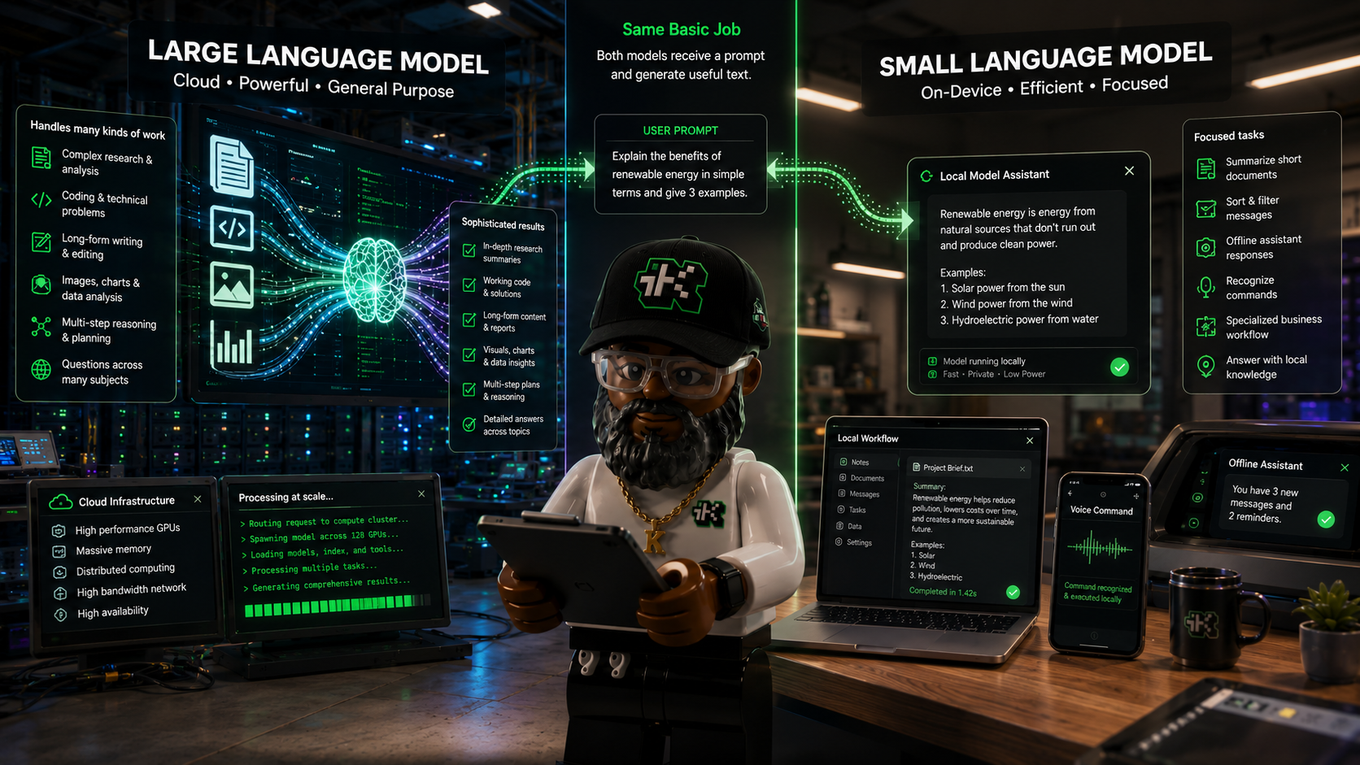
Each layer fits inside the one before it, like boxes nested in bigger boxes. Every generative AI system is deep learning, every deep learning system is machine learning, and every machine learning system is AI. It doesn't run the other way. A hand-coded rules engine can be AI without ever touching machine learning, and a machine learning model can predict tomorrow's sales without generating a single new thing. This is the same nesting that separates a large language model from a small one: both are generative, and the differences show up further down the stack.
Why the difference is worth knowing
Knowing where generative AI sits pays off in the decisions you make at work. When someone says "let's add AI to this," the useful next question is which kind. A tool that flags risky invoices, routes support tickets, or predicts which customers might leave is discriminative AI, and it may be exactly what the job needs. Reaching for a chatbot there would be the wrong tool.
It also keeps the hype in proportion. Generative AI is the loud, visible part of the field right now, but it's a thin slice of everything AI does. A lot of the AI already earning its keep inside businesses is the quiet discriminative kind that sorts and predicts. If you're weighing how a team or a small business should put these tools to work, sorting the two is the first move, and it's the kind of thing I'm always happy to talk through in a quick conversation. For a sense of how the generative side fits into real daily work, here's how I use ChatGPT, Claude, and Gemini day to day.
A quick way to keep it straight
Think of AI the way you'd think of "transportation." That word covers everything from a bicycle to a cargo ship. Generative AI is like electric cars inside that category: a specific, recent, very visible type that gets most of the headlines, while the buses, trains, and delivery trucks keep moving the world around in the background. Generative AI is a real and capable branch of the field, powerful and everywhere right now, and still a small part of everything the word "AI" includes.
Next time you hear "AI," you don't have to take it as one blurry blob. You can place it: is this the kind that sorts and predicts, or the kind that makes something new? That one question turns a buzzword back into something you can reason about.
Sources:
ibm.com: AI vs. machine learning vs. deep learning vs. neural networks ·
developers.google.com: background on generative models ·
coursera.org: discriminative vs. generative models ·
freecodecamp.org: machine learning vs. deep learning vs. generative AI ·
nature.com: AI models collapse when trained on recursively generated data ·
forbes.com: Ohanian and Altman warn of the dead internet theory