
I was catching up with a friend recently, talking through the latest advancements in AI that have me in a chokehold of curiosity, and also some of what I've been working on, when they hit me with something that has been a common sentiment for people who have yet to integrate the tech into their daily life. They aren't a fan of how fast AI has become ingrained in everything, and it comes from a place of concern for our critical thinking. This is a highly successful person whose entire career is built on strategic thought and they don't want to get caught relying on a tool so much that they lose the ability to really go deep. I felt this deeply.
That conversation sent me on a thought spiral because I think there are a lot of people with that apprehension, myself included. It's why I think it's so important to not only integrate AI, but also know how to unplug and connect in real life with books, with writing, and with content created by humans, for humans.
Because let's be real: we're all using it. For writing, for brainstorming, for getting unstuck on that thing we've been staring at for an hour. And there's this question that's usually thought quietly but this conversation made me ask out loud: Is AI making us dumber? Not dumber like we can't tie our shoes, but are we losing the ability to think through hard problems ourselves? Are we offloading the exact mental muscles we need to stay sharp?
I did some research (not the real kind though, you know the internet searches and reading some articles type research) to see if AI is killing our critical thinking, and to keep it a buck? It's tricky. What I learned is more nuanced than "AI is the devil" or "AI is a God send" — it's showing us exactly what happens to our brains when we lean too hard on these tools.
It comes down to a simple truth I share in a lot of my workshops: Your brain is a muscle! Just like any other muscle, if you stop working it out, it isn't going to be as strong as it was when you were putting in the work.
What the Research Says
A UK study tracked over 650 people and found something wild. There's a negative correlation between AI use and critical thinking scores. We're talking r = -0.68 (I had to google this and that number is strong, by the way). The more people used AI, the worse they performed on critical thinking tests.
The problem isn't the AI itself. It's what psychologists call "cognitive offloading." That's a fancy way to describe when you let the tool do the thinking instead of using it to help YOU think better.
Another study put Chinese university students in three groups to revise English essays. One group got ChatGPT. One got human tutors. One got a checklist. The ChatGPT group's essays looked the best. Quality went up, grammar improved, all that good stuff.
Makes sense, right?
Except when researchers dug a lil deeper, they found those students spent way less time reviewing their source materials. They just copied what the AI gave them, even though they were told not to. Their essays got better, but their understanding? Goose eggs. Zeros in the chat.
They outsourced the learning part.
The Younger You Are, The Harder It Hits
If you're between 17 and 25, you're getting hit the hardest by this. The same UK research showed younger users had the highest AI dependence and the lowest critical thinking scores. Honestly, if you've been on TikTok for more than a few scrolls, you were probably already aware of the critical thinking gap, but I digress.
Education helps. People with more formal education showed some buffer against these effects. But it didn't make them immune. Even knowledge workers with college degrees showed reduced critical thinking when they had high confidence in AI, according to a 2025 Microsoft study.
People with more education seem to dodge some of these effects. They've already built strong thinking habits, so they use AI more like a tool than a crutch. But if you're still developing those skills? You might be building your house on sand.
Where AI Helps Critical Thinking
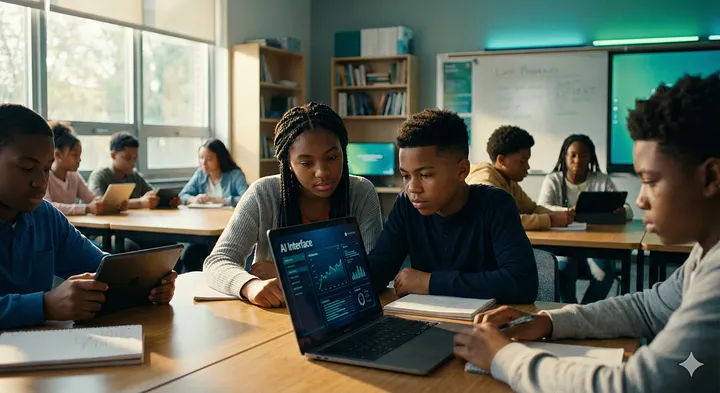
Real talk though — AI can help critical thinking in specific contexts. Research showed that structured AI feedback in literature classes improved critical thinking. But notice that word: structured. There were guardrails in place. Teachers designed how students interacted with the AI rather than just letting them dump prompts into ChatGPT and call it a day. Reading that got me excited because I've had so many conversations with educator friends about this. If we focus on intertwining the tech into lessons and teaching best practices instead of just trying to block it, everyone wins.
The difference? Active engagement vs. passive acceptance.
This matches what Anthropic (Claude.Ai) found in their data: 40% of students use Claude for creating content, 30% for analyzing concepts. When it's a thinking partner and not a thinking replacement it can speed up the parts that don't need deep thinking so you can focus on the parts that do.
That's the sweet spot. Using AI to handle the grunt work while you stay engaged with the actual thinking.
Here's What Happens In Your Brain
Researchers found when they watched people work with AI they spend less time evaluating their own work, have reduced motivation to understand the topic, and give superficial analysis of the results.
They call it a word combo that I had never heard of, "metacognitive laziness." That's thinking about your thinking. Asking yourself: Does this make sense? What am I missing? How do I know this is right?
When AI gives you an answer that sounds good, your brain wants to just accept it and move on. That dopamine hit of "task complete" is real. But you're skipping the part where you learn something.
So basically you're literally practicing NOT thinking at the times when thinking matters most.
So, Who Does AI Help?
Most of these tools have free tiers. ChatGPT, Claude, the major players you can use without paying. That's good for access. But here's where it gets tricky: if you don't already have strong critical thinking skills, or if you're not in an environment that's teaching you how to use these tools strategically, you're at higher risk of the negative effects.
Basically, if you already know how to think critically, AI can be a power tool. If you're still building those skills? AI can stunt your growth if you're not careful. That last sentence kinda sounds like those anti-smoking campaigns of the 90's, but I'm keeping it!
Jokes aside, lack of those skills are another issue that creates a gap. People with resources, education, and structured support get the benefits. Younger folks, people with less formal education, people without mentors showing them how to engage with AI critically? They're the ones getting hurt most.
This isn't just about individual choices. It's about who has access to the knowledge of HOW to use these tools right.
WTF Can We Do About This?
First, recognize when you're offloading vs. engaging. If you're using AI and learning nothing, that's a red flag.
Try this: After AI gives you an answer, pause. Ask yourself what parts you understand and what parts you're just accepting because they sound smart. Make yourself explain it in your own words.
Use AI for the parts AFTER you've done your own thinking. Brainstormed your ideas first? Great, now see what AI adds. Tried to solve the problem yourself? Cool, now check your work with AI. But don't start with AI and end with AI. That's where skills die.
For educators and managers: Build scaffolding. Don't just let people loose with chatbots. Create assignments and workflows that require human judgment, synthesis, and evaluation. Make the AI a tool within a larger process, not the whole process.
Hell, I use AI to help me flesh out some of my ideas or take my thought streams and take them from disjointed but connected ramblings into a clear narrative. But it all starts with my own ponderings and curiosity which is my muscle working itself out, but sometimes a spotter can be good on the heavier lifts. Sometimes I opt to not use it as some tasks are MEANT to be hard because that's where the learning happens. Struggling through a problem builds the exact cognitive muscles that make you capable.
The Bottom Line
AI isn't fundamentally ruining our ability to think. But using it without awareness definitely can and will.
The question isn't "Is AI good or bad for thinking?" It's "How are YOU using it, and what are you losing or gaining in the process?"
Start paying attention to that. Because the skills you don't use, you lose. And critical thinking is one you can't afford to outsource.
Stay curious, stay learning. ✌🏾
— Kan