
AI tools are entering classrooms fast — but what does that mean for Black and Brown students? Here's what every parent needs to know. and honestly? For Black & Brown kids, this whole thing can be more complicated than it appears.
I'm not here to tell you AI is saving our kids or ruining them. I'm here to break down some of what's really happening, what you need to watch for, and how to help your student navigate this without losing their mind or their critical thinking skills.
AI Is Already in Your Kid's Classroom.
Not coming soon — already there.
We're talking about tools that can:
- Tutor kids in math and adjust to how they learn
- Help with essay writing (sometimes too much)
- Translate assignments for multilingual students
- Generate practice problems based on what they're struggling with
- Create study guides customized to their needs
At HBCUs, 98% of students are already using AI tools. Your middle schooler? They probably are too, whether the school told you or not.
Here's the thing nobody's saying out loud: these tools can be genuinely helpful for our kids, especially when they're catching up from pandemic learning loss or need extra support that overwhelmed teachers can't always give. But they can also reinforce the same biased nonsense our kids already deal with — just faster and in more convincing packaging.
When AI Works for Our Kids
Personalized Learning That Meets Them Where They Are
When I was struggling with statistics at 13, I had two options: figure it out or fail. Your kid has AI tutors that can explain the same concept seventeen different ways until it clicks.
Tools like Khanmigo and DreamBox watch how your student works through problems and adjust in real-time. Kid keeps missing fraction questions? The AI notices and gives them more practice there. That's genuinely useful, especially for students who fell behind during COVID.

Research shows this personalized approach helps low-income students and students of color the most. Makes sense — our kids often don't get the small class sizes or individual attention that makes traditional learning work. AI can fill some of that gap when used thoughtfully.
The key word there? Thoughtfully. The same technology that can provide personalized support can also widen achievement gaps if only well-resourced schools get access to the good stuff.
Building Skills That Change Who Gets a Chance
Here's something worth paying attention to: 71% of Black adults surveyed said they need new AI skills for work or education. This isn't theoretical — it's already affecting job opportunities.
Your kid learning to use AI tools now? That's not cheating. That's learning the tools of their future workplace. Same way our parents made sure we could type, you want your kid comfortable with AI before they hit the job market.
Plus, if your student gets into building AI — programming these tools, not just using them — they're positioning themselves to shape technology that affects our communities. Healthcare algorithms, education platforms, hiring systems — all of that needs Black people at the table making decisions.

Right now, Black workers make up only 2% of AI roles at major tech companies. Your kid developing these skills early? That starts changing those numbers.
Breaking Down Language Barriers (When Done Right)
For students who are immigrants or speak multiple languages, AI translation and bilingual learning tools make a real difference. Your kid can get explanations in their home language, then practice in English. That's powerful.
And when AI tools are designed well and with cultural competence, they can help create curriculum that reflects our culture and history — not just the sanitized version. The emphasis here is "when designed well." That's not always the case.
The Uncomfortable Truth
When the Machine Tells Your Kid Their Voice Needs 'Fixing'
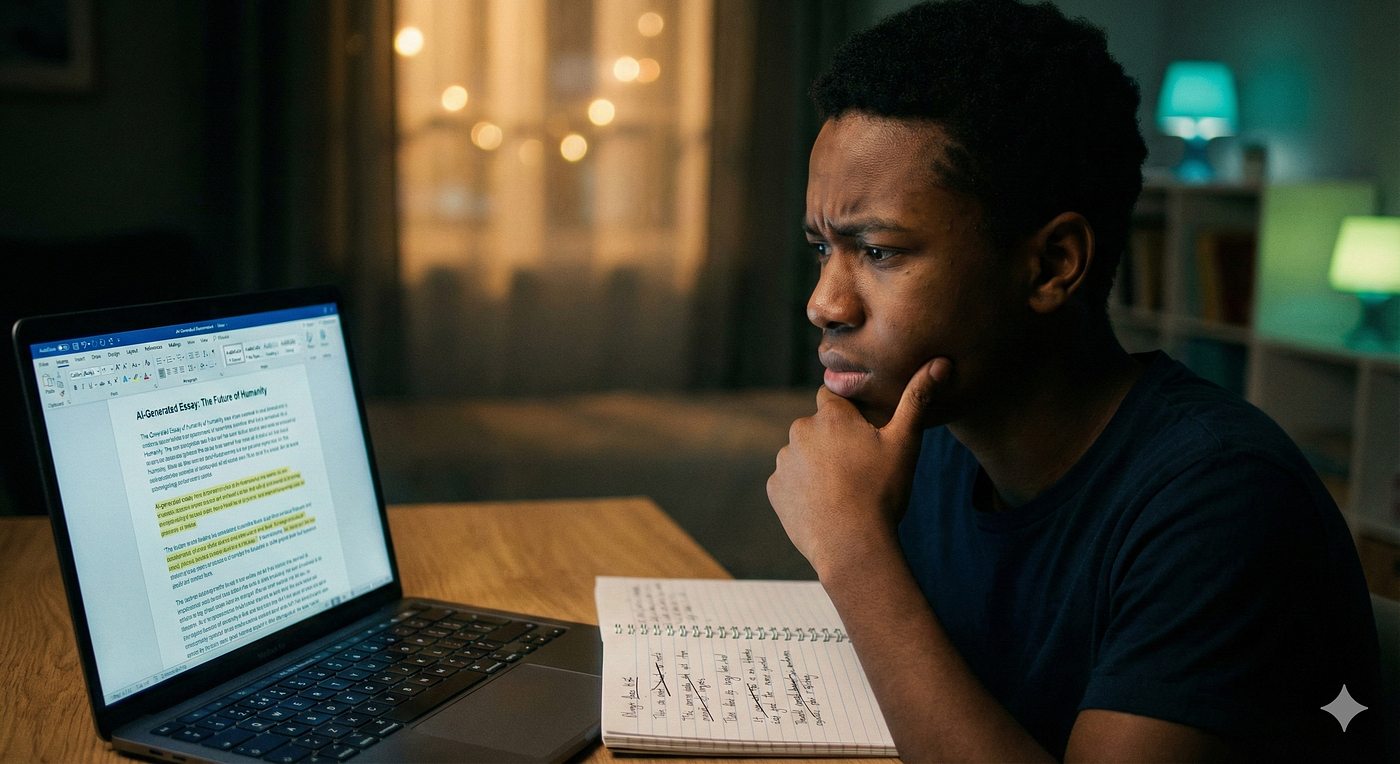
Here's what teachers are seeing: Black students using AI to write essays often start second-guessing their own voice. Why? Because AI writes in standard academic English that doesn't sound like how many of our kids naturally communicate.

One educator put it perfectly: "The idea of perfection does not look like us… does not sound like us."
Your kid writes something authentic, then asks ChatGPT to "improve" it, and suddenly their unique perspective gets smoothed into generic "good student" writing. Over time? They start believing their natural voice isn't good enough.
That's not confidence-building. That's code-switching on steroids, except now it's a machine telling your kid their way of expressing themselves needs "correction."
The Bias Is Built In
Remember when that resume-scanning AI kept ranking white names higher than identical Black names? Educational AI has the same problem.
These systems were trained on internet content and textbooks that reflect society's biases. Ask them about Black history and you might get watered-down versions. Ask about crime or achievement gaps and you might get answers reinforcing stereotypes.

A 2023 study found that when AI systems generate images of "professionals," they overwhelmingly show white people. When asked to generate images related to "criminal activity," the results skew toward people of color. Your kid absorbing these patterns? That shapes how they see themselves and their potential.
Your kid using these tools needs to know: the AI doesn't have all the answers, and some of the answers it gives are wrong — sometimes in ways that specifically harm Black people.
Access Isn't Equal (Surprise, Surprise)
Here's the part that makes me tired: access isn't equal.
While schools in well-funded districts are rolling out premium AI tutoring platforms, schools in under-resourced areas are still fighting for basic internet access. The digital divide doesn't disappear just because the technology gets fancier.

Your kid might have AI tools at school but no reliable internet at home to practice with them. Meanwhile, kids in wealthier districts are getting AI homework help 24/7, access to premium tools their parents pay for, and teachers trained specifically in AI literacy. Guess who that benefits?
The pattern is familiar: new technology gets introduced as "the great equalizer," but without intentional effort toward equity, it just amplifies existing advantages.
Critical Thinking Takes a Hit
MIT research found that students using ChatGPT for writing assignments had "diminished learning outcomes" compared to students who worked through problems themselves.
Translation: when kids lean on AI too hard, they stop developing the thinking skills that matter. They can generate an essay without understanding the material. They can solve math problems without learning the underlying concepts.

For Black students who already face low expectations and inadequate instruction in many schools, becoming dependent on AI as a crutch instead of using it as a tool is a real risk. The last thing our kids need is another system that lets them slide by without learning — especially when they'll be competing against students who are using AI strategically while still developing core skills.
The Questions You Should Be Asking Right Now
At School:
- Is your kid's school using AI tools? Ask directly. Don't wait for them to send a letter home.
- What's the AI literacy curriculum? Are they teaching kids to think critically about these tools or just to use them?
- Who has access? Are all students getting the same AI resources or just students in certain programs or tracks?
- How are teachers trained? Are they equipped to teach with AI thoughtfully, or are they figuring it out as they go?
- What's the policy on AI use? Is it clear when AI assistance is appropriate versus when it's considered cheating?
At Home:
- Does your kid understand what AI can and can't do? Have real conversations about it.
- Are they questioning AI outputs? Or accepting everything it generates as truth?
- Is AI helping them learn or replacing learning? There's a difference between using AI to understand a concept better and using it to avoid thinking.
- Can they still write/think/solve problems without it? That's the real test.
- Are they maintaining their voice? Watch for signs they're starting to doubt their own way of expressing ideas.
How to Help Your Student Navigate This
Have the Conversation
Ask your kid: "Are you using AI for school?" Not in a "gotcha" way — in a "let's talk about this tool" way.
Listen to how they're using it. Are they asking it to explain concepts they don't understand? That's productive. Are they copying and pasting answers without reading them? That's not.

The goal isn't to catch them doing something wrong. It's to understand how they're thinking about these tools so you can guide them toward using AI strategically instead of dependently.
Teach Healthy Skepticism
Your kid needs to know that AI isn't some all-knowing oracle. It's software trained on internet content — including all the biased, inaccurate garbage the internet contains.
When they get an AI-generated answer, teach them to ask:
- "Does this make sense to me?"
- "What's missing from this explanation?"
- "Would this answer be different if I were a different race or from a different community?"
- "Can I verify this information somewhere else?"
- "Is this answer reinforcing stereotypes or challenging them?"
That critical lens matters for everything they consume online, but it's especially important with AI because it presents information with such confidence — even when it's wrong.
Set Boundaries That Make Sense
Don't ban AI outright — that's not realistic and it doesn't prepare them for the world they're entering.
Instead, talk about when it's appropriate:
Good uses: Using AI to brainstorm ideas for an essay. Asking AI to explain a concept in different ways until it clicks. Getting feedback on rough drafts. Generating practice problems for concepts they're struggling with. Translating between languages when learning.
Problematic uses: Having AI write their entire essay and submitting it as their own. Using AI instead of learning the material. Accepting AI-generated answers without verification. Letting AI replace their voice and perspective. Using AI to avoid thinking through challenging concepts.
The line isn't always clear, and that's okay. What matters is that they're thinking about it.
Protect Their Voice
This one's crucial. Your kid's perspective matters. Their lived experience matters. Their way of expressing themselves matters.
If they're using AI to write, remind them: the goal isn't to sound like everyone else. The goal is to communicate their ideas clearly while maintaining their authentic voice.
When they turn in work, you want the teacher to hear your kid's thinking, not ChatGPT's generic academic prose. There's power in being able to code-switch when necessary, but there's also power in knowing when not to — in understanding that their voice has value exactly as it is.
Look for Creator Opportunities
If your student shows interest in how AI works, support that. Programs like Black Girls CODE and initiatives focused on positioning Black students as builders of AI — not just users of it — are worth exploring.
Those are the opportunities that lead to real power: shaping the technology instead of just consuming it. The students who learn to build AI systems are the ones who'll have influence over how those systems treat people who look like them.
Right now, the people building AI systems don't reflect the diversity of the people those systems affect. Your kid getting into this field? That starts changing the equation.
What Good Implementation Looks Like
Some schools and programs are getting this right. Here's what they're doing:
They're teaching AI literacy, not just AI use. Students learn to recognize bias, question outputs, and think critically about when AI helps versus when it hinders. They're not just learning to use ChatGPT — they're learning to evaluate whether what ChatGPT tells them is accurate, complete, and fair.

They're addressing access gaps. Making sure all students have the tools and internet they need, not just kids from wealthy families. This means device lending programs, extended school hours for computer lab access, and partnerships that provide home internet.
They're centering diverse creators. Programs that specifically support Black students as AI developers and innovators, not just skilled workers who use tools others built.
They're preserving critical thinking. Using AI to support learning, not replace it. The technology enhances what teachers do — it doesn't let students bypass the hard work of learning.
They're having honest conversations about bias. Not pretending AI is neutral, but actively teaching students to spot and question biased outputs. Making AI literacy part of digital literacy curriculum from elementary school forward.
Here's What Matters
AI in education isn't going away. The question isn't whether your kid will encounter these tools — it's whether they'll use them thoughtfully or thoughtlessly.
For Black students, the stakes are higher. These tools can provide genuine support and open doors to careers that need more Black voices. But they can also reinforce biases, erode authentic voice, and widen existing gaps if we're not paying attention.
Your job isn't to become an AI expert overnight. It's to:
- Stay informed about what's happening at your kid's school
- Have ongoing conversations about how they're using these tools
- Teach them to question what AI tells them
- Help them maintain their voice and critical thinking skills
- Support their interest if they want to move from user to creator

Your kid is growing up in a world where AI will be everywhere — in their education, their careers, their daily lives. The students who thrive won't be the ones who avoid AI or the ones who depend on it completely. They'll be the ones who learn to use it strategically while maintaining their ability to think, create, and problem-solve independently.
That's the skill set worth building. And you don't need to be a tech expert to help your kid develop it — you just need to stay engaged, ask questions, and remind them that the most powerful technology they have is still the one between their ears.
Sources & Further Reading:
Business Insider: HBCU Students and AI Usage ·
Brookings: AI and Educational Equity ·
Pew Research: Black Americans' Views on AI ·
McKinsey: Diversity in Tech ·
Education Week: Black Educators' Perspective on AI ·
Brookings: Algorithmic Bias ·
Pew Research: Digital Divide ·
MIT News: ChatGPT and Learning Outcomes ·
Black Girls CODE