
Bloom's Taxonomy is a model for ranking thinking skills from simple to complex: remembering a fact, understanding it, applying it, analyzing it, evaluating it, and creating something new from it. Benjamin Bloom's team published the original version in 1956. A 2001 revision, led by Lorin Anderson and one of Bloom's original co-authors, David Krathwohl, updated the language and reordered the top two levels.
Both versions still show up constantly in workplace training, including the AI training a lot of companies are rushing to put together right now. Here's what each version says, and what it looks like when a team goes through it.
The original six levels, from 1956
Bloom and his co-authors, Max Englehart, Edward Furst, Walter Hill, and David Krathwohl, built the original taxonomy around six nouns, each one describing a level of thinking a learner could reach:
- Knowledge: recalling a fact, term, or procedure
- Comprehension: explaining that fact in your own words
- Application: using it to solve a new problem
- Analysis: breaking it into parts and seeing how they connect
- Synthesis: combining pieces into something new
- Evaluation: judging the value or correctness of something using clear criteria
Most one-off trainings, the kind where someone reads slides for an hour, stop at Knowledge and Comprehension. People can recall what a tool does. They rarely get to Application or beyond, because nobody gave them the time or the task to practice it.
What changed in the 2001 revision
Anderson and Krathwohl's revision, published as "A Taxonomy for Teaching, Learning, and Assessment," made three changes worth knowing.
First, the nouns became verbs: Remember, Understand, Apply, Analyze, Evaluate, Create. A verb describes something a learner does, which makes it easier to write a training goal around and easier to check whether someone reached it.
Second, the top two levels swapped places and Synthesis got a new name. Evaluate moved to level five. Create, formerly Synthesis, moved to the top, on the reasoning that building something original takes the judgment evaluation requires, plus more.
Third, the revision added a separate knowledge dimension: factual, conceptual, procedural, and metacognitive knowledge, combined with the six thinking levels. That part matters more for people who design curricula for a living than for a manager sitting through Tuesday's training, so we won't dwell on it here.
The six levels applied to a real AI rollout
Here's what those six levels look like when a team gets trained on a generative AI tool, meaning software like Claude or ChatGPT that produces new text, image, or code output from a written instruction, instead of just retrieving information someone already wrote.
Say a mid-size company rolls out an AI writing tool to its marketing team. A training built around the revised taxonomy would move people through all six levels, not just the first two:
- Remember: an employee can name the tool and define a prompt, meaning the instructions or question you type in to get a response.
- Understand: they can explain in their own words what the tool is good at and where it needs a human check.
- Apply: they use it to draft something real, like a client update or a first pass at a social post.
- Analyze: they compare two AI-written drafts side by side and spot where one contains a hallucination, meaning the tool stated something confidently that isn't true.
- Evaluate: they judge which of the two drafts is fit to send, and can explain why using the team's own standards for accuracy and tone.
- Create: they build a reusable prompt or a short process for a task their team repeats every week, and hand it off to a teammate.
A training that stops after "Remember" produces employees who can describe the tool at a dinner party. A training that reaches "Create" produces employees who change how their team works.
Why most workplace AI training stalls at the bottom
This gap is not hypothetical. Gallup's Q2 2026 workforce survey found 52% of U.S. employees now use AI in their role, and the most common uses are writing and editing (51% of AI users) and search or research (49%). Those are largely Apply-level tasks: using the tool, not yet analyzing or judging its output.
The same survey found a real payoff for going further. Employees who use AI for more specific, technical tasks, like coding assistance or process automation, report meaningfully higher productivity gains (77% positive) than employees who stick to writing and editing (68% positive). The people getting the most value aren't using AI more often. They're using it in more advanced ways, which is a description of moving up Bloom's ladder.
McKinsey's "Superagency in the Workplace" report found a related pattern at the company level: 92% of companies plan to increase AI investment over the next few years, but only 1% of leaders describe their company's AI use as fully mature. Employees in that same research said they want structured training, not just tool access. Handing someone a login gets them to Remember. It doesn't get them to Create.
How to use this if you're building or sitting through AI training
If you're designing the training: pick the level you need people to reach before you build a single slide, and build backward from there. A team that only needs to recognize when a document was AI-drafted needs a different session than a team that needs to build their own AI-assisted workflow.
If you're the one taking the training: notice which level the session is aiming for. If it stops at "here's what the tool does," ask for time to use it on something from your own workload before the session ends. That's the difference between a training that sticks and one you forget by Friday.
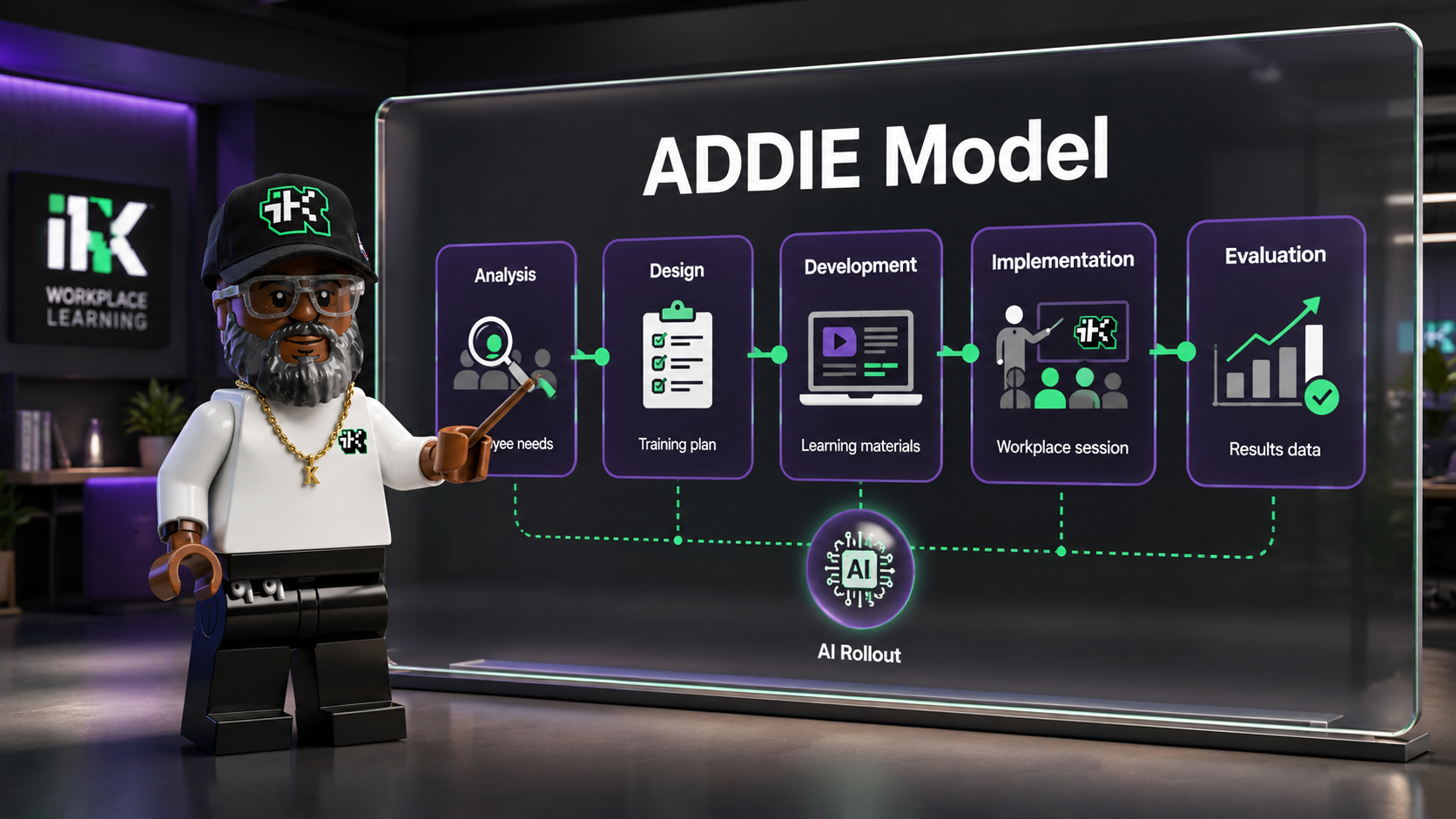
Pair this with the ADDIE model if you're the one responsible for building the training end to end. Bloom's Taxonomy helps you pick the target. ADDIE, the five-step process instructional designers use, helps you build the actual course around it.
That's the kind of design work behind the workshops and training programs I run. If you want help building an AI training program that gets your team past "Remember," the free 15-minute call is the place to start. You can also see the workshops and programs I run in the What I Offer section.
Sources
- Vanderbilt University Center for Teaching, "Bloom's Taxonomy": https://cft.vanderbilt.edu/guides-sub-pages/blooms-taxonomy/
- Anderson, L.W. & Krathwohl, D.R., "A Taxonomy for Teaching, Learning, and Assessment" (2001 revision, excerpt via Quincy College): https://quincycollege.edu/wp-content/uploads/Anderson-and-Krathwohl_Revised-Blooms-Taxonomy.pdf
- Gallup, "Organizational AI Adoption Jumps Six Points" (July 20, 2026): https://www.gallup.com/workplace/712736/organizational-adoption-jumps-six-points.aspx
- McKinsey, "Superagency in the Workplace": https://www.mckinsey.com/capabilities/tech-and-ai/our-insights/superagency-in-the-workplace-empowering-people-to-unlock-ais-full-potential-at-work
Notes marked as my process or professional opinion are exactly that, not external data.