
Gagné's Nine Events of Instruction is a nine-step sequence for building a single lesson, from getting a learner's attention at the start to making sure the skill sticks after it ends. Robert Gagné laid it out in his 1965 book "The Conditions of Learning," and it's still one of the most direct, practical guides for structuring one training session, including a session teaching people to use AI at work.
The nine events, in order
- Gain attention: give learners a reason to focus before you present anything.
- Inform learners of the objective: tell them exactly what they'll be able to do by the end.
- Stimulate recall of prior learning: connect the new material to something they already know.
- Present the content: deliver the actual information or demonstration.
- Provide learning guidance: walk through examples, not just facts.
- Elicit performance: have learners do the thing themselves.
- Provide feedback: tell them specifically what they got right and what to fix.
- Assess performance: check whether they can do it without help.
- Enhance retention and transfer: give them a way to keep using the skill after the session ends.
The nine events applied to one AI training session
Say a manager is running a 45-minute session teaching a team to use a generative AI tool, meaning software like Claude or ChatGPT that produces new text, image, or code output from a written instruction, to draft weekly status updates.
- Gain attention: open with a real status update someone spent 25 minutes writing, next to one an AI tool drafted in two minutes with a few errors in it. Both matter to the point.
- Inform of objective: tell the team that by the end, everyone will draft a status update in under five minutes and know how to check it for mistakes before sending.
- Stimulate recall: ask what usually makes a status update take so long to write, and what people already do to double-check their own work.
- Present content: define a prompt, meaning the instructions or question you type in to get a response, and demonstrate the tool live on a real update.
- Learning guidance: walk through one full example out loud, narrating each choice: what to include in the prompt, what to cut from the draft, what to double-check.
- Elicit performance: everyone drafts their own real status update with the tool, right there in the room.
- Feedback: the instructor and a partner point out anything the draft overstated, understated, or got wrong before it goes out.
- Assess performance: each person checks their edited draft against a short accuracy checklist from step two.
- Retention and transfer: send everyone home with the exact prompt template and ask them to bring back one real example they used it on the following week.
Why the order matters, not just the list
Most one-off AI trainings skip straight to "present the content": here's the tool, here's what it does. That's step four, and it's the fifth event out of nine. Skipping the first three means learners never got a reason to pay attention, never knew what they'd be able to do, and never connected it to anything they already understood.
Skipping the last three matters just as much. Research on training transfer, cited in an earlier post on introducing AI training to a non-technical team, found that a large share of what's taught in a single session never reaches real work without practice and follow-up. Events six through nine, performance, feedback, assessment, and transfer, are exactly the steps that turn a lecture into something people can still do a month later.
Gallup's Q2 2026 workforce survey backs this from the productivity side: employees who use AI for a wider variety of tasks report far bigger productivity gains than employees using it for just one or two things, in Gallup's own data, 90% positive among people using seven or more use cases, versus 45% positive among people using just one or two. Range comes from practice, and practice is what events six and seven are built to create.
How to use this if you're building a single AI training session
Write the objective, step two, before you write a single slide for step four. If you can't say exactly what someone will be able to do by the end, the content isn't ready to build yet.
Budget real time for events six and seven. If people watch you use the tool for forty minutes and get five minutes to try it themselves, the ratio is backward.
Build step nine into the session itself: hand people the prompt or template they'll reuse, not a summary of what you covered.
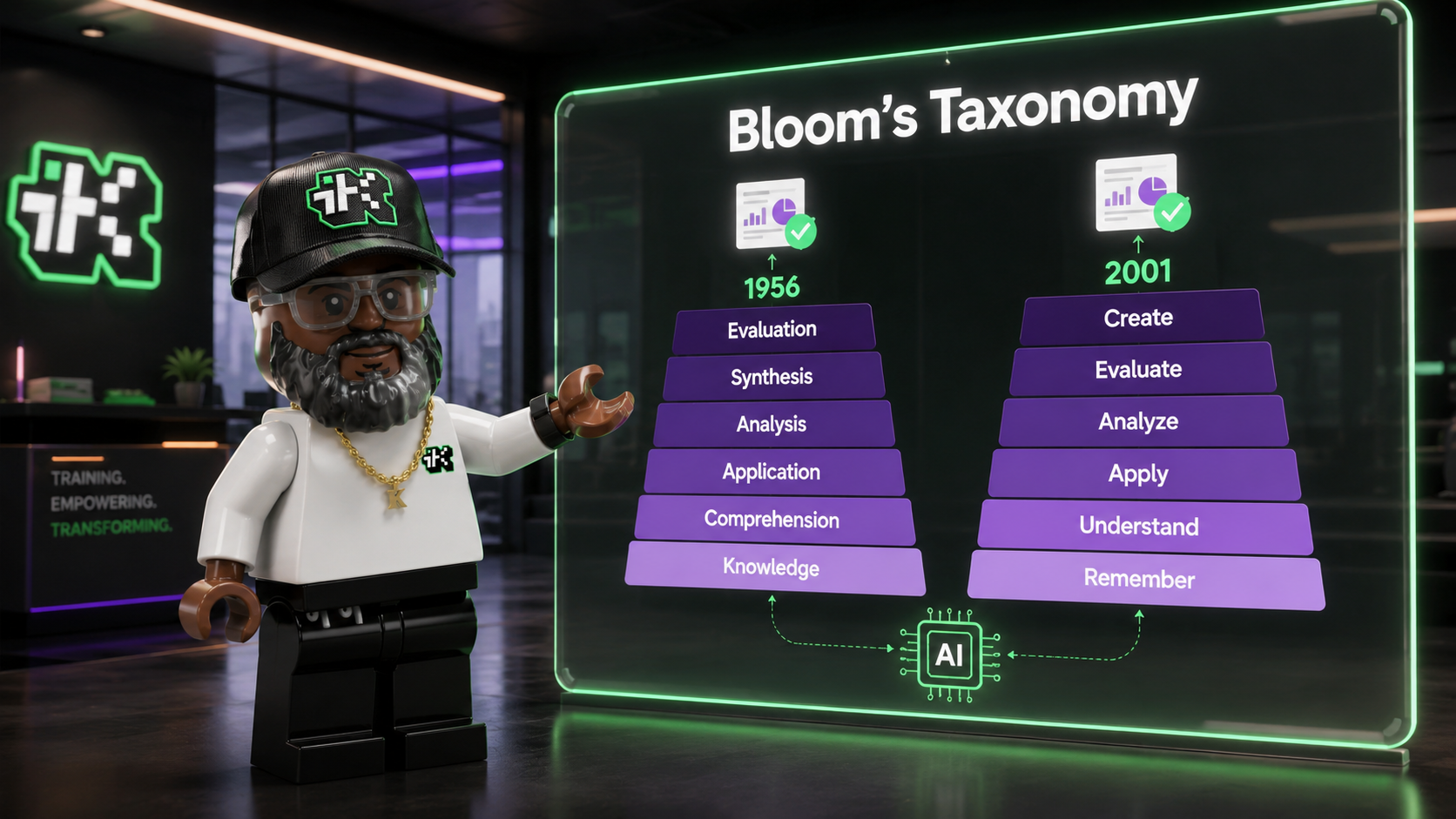
Gagné's nine events describe one session. If you're structuring a full AI training program across multiple sessions, that's the layer the ADDIE model handles, and Bloom's Taxonomy helps you pick how far each session needs to go.
That's the kind of session design behind the AI and digital literacy training I build for teams and organizations. If you want help structuring a session like this for your team, the free 15-minute call is the place to start. You can also see the workshops and programs I run in the What I Offer section.
Sources
- Northern Illinois University, Center for Innovative Teaching and Learning, "Gagné's Nine Events of Instruction": https://www.niu.edu/citl/resources/guides/instructional-guide/gagnes-nine-events-of-instruction.shtml
- Wikipedia, "Conditions of Learning" (1965 publication history): https://en.wikipedia.org/wiki/Conditions_of_Learning
- Gallup, "Organizational AI Adoption Jumps Six Points" (July 20, 2026): https://www.gallup.com/workplace/712736/organizational-adoption-jumps-six-points.aspx
- Training transfer research overview: https://www.shiftelearning.com/blog/factors-that-affect-the-transfer-of-training
Notes marked as my process or professional opinion are exactly that, not external data.