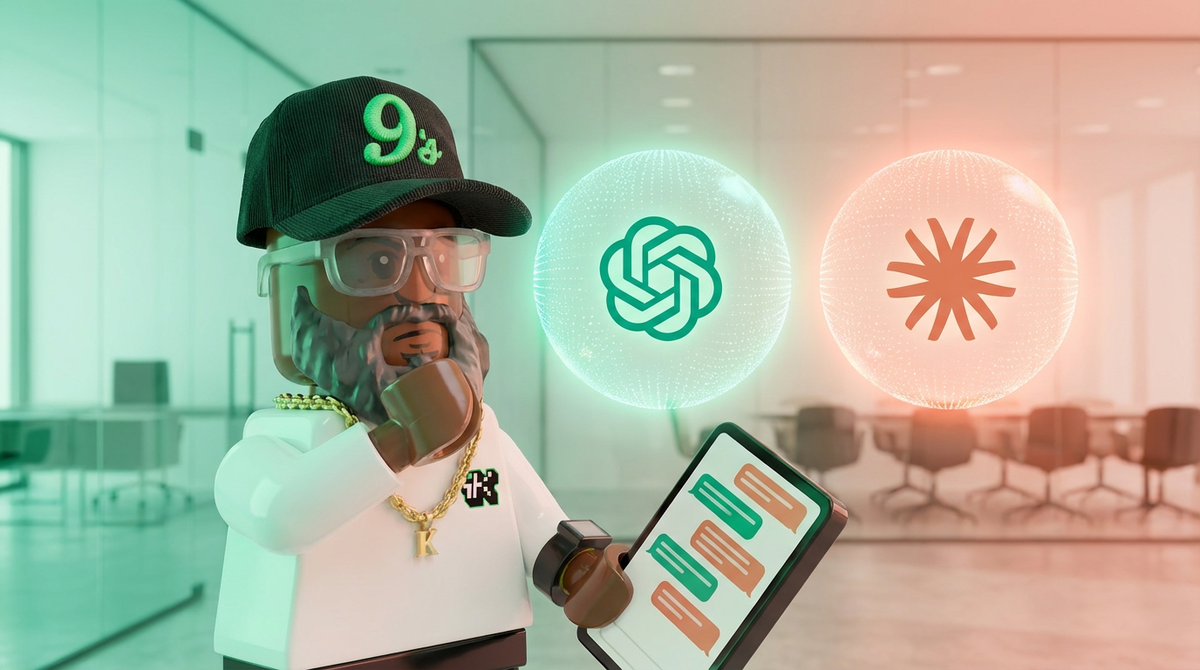

I've been working with Claude a lot lately, and I'm finding that I really like it. Like, really like it.
And I'm not the only one noticing the difference. You know what I've been hearing more in the culture? People talking about the energy of these LLMs, how Claude is that older sibling who got their life together and will pop you in the back of your neck real quick to let you know, "Uh uh, that ain't the way to do it. Let's do this over here the right way." Meanwhile, ChatGPT is that supportive friend who's too supportive, the one who'll say "yeah, let's do it!" even when y'all both about to get into some wildness.
That metaphor? It tracks. Because after years of paying for both platforms, building automation workflows, writing newsletters, and switching between them for different tasks, I'm finding Claude is becoming my go-to for the work that needs that extra eye for detail. Not because one's "better" across the board — that's not what this is about. But because the tool matters based on what you're trying to accomplish.
Let me show you what I mean.
What We're Working With
Both ChatGPT (made by OpenAI) and Claude (from Anthropic) are large language models — AI trained on massive amounts of text to understand and generate human-like responses. They're both smart as hell, but they got different personalities and strengths.
ChatGPT is the one that kicked this whole thing off for most of us. This is what got people aware of LLMs and chatbots in general, and I'll always have a special place in my heart for it. It can generate images, search the web in real-time, do voice conversations, handle math problems, and you can even build custom GPTs for specific tasks. It's fast, versatile, and the free version gets you pretty far. The paid version (ChatGPT Plus, around $20/month) unlocks deeper features.
But here's the thing about being first: sometimes the newer kids learn from what you did and do it better.
Claude is more specialized. It's built with something called Constitutional AI, which basically means it's trained to be more careful, more consistent, and way better at understanding context. It can't generate images or do voice stuff, but what it can do is handle massive documents (we're talking up to 200K tokens — that's like entire codebases or 500-page reports) and write in a way that sounds human. Claude Pro runs about the same price as ChatGPT Plus.
When ChatGPT Does Its Thing
ChatGPT still wins for certain things, and I use it regularly for specific tasks.
Research and citations: When you need to deep-dive on a topic with actual sources, ChatGPT's research mode pulls 40+ citations and links to credible journals. I've used it to map out digital marketing strategies and it came back with academic sources I could verify. Claude's research? Surface level, fewer citations, still in beta.
Image generation: ChatGPT makes images right in the chat. Logo concepts, visuals for presentations, whatever you need — it'll generate it. Claude can't do that. You'd need to bounce over to another tool.
Thought streaming and structure: This is where ChatGPT shines for me. When I'm trying to organize messy ideas or work through a logical structure for something, ChatGPT helps me see the shape of my thinking. It's that brainstorming friend who helps you map out possibilities without judgment.
Quick everyday tasks: ChatGPT is faster for general stuff — quick questions, basic code snippets, initial brainstorming. It's the all-in-one toolkit that covers most bases. Think of it for book reports, research papers, exploratory writing — the creative liberties and freedoms.
Multimodal work: Voice conversations, analyzing images you upload, web browsing — ChatGPT does all that natively. Claude can analyze images and charts you give it, but no video, no audio, no web search built in.
Where Claude Gets the W
Now here's where it gets interesting, especially if you're writing copy, marketing content, coding real applications, or trying to sound like an actual person instead of a corporate press release.
Copy generation and writing: This is the big one. When you compare the writing quality side by side, Claude produces text that feels natural — less corporate fluff, more consistent tone, better flow. ChatGPT can be engaging, but it tends to sound academic or generic. You know that "AI voice" people complain about? That's usually ChatGPT.
Same prompt, both tools. "Write a product description for noise-canceling headphones targeting remote workers." ChatGPT gave me five paragraphs of feature dumps with words like "revolutionize" and "seamlessly integrate." Claude? Shorter, punchier, talked about the headache of kids screaming in the background during Zoom calls. It got it.
And here's what really frustrates me about ChatGPT: no matter how detailed my prompts are, no matter what I put in custom GPT system instructions, it keeps reverting back to its way of doing things. I've spent hours trying to get it to drop words like "delve," "unlock," "seamless" — all that fluff nobody says. I'll set up projects with specific tone guidelines, even negative examples of what NOT to do, and ChatGPT will still slip that corporate-speak back in.
Claude? It has this Styles feature where you can set a custom writing style and it maintains that tone. But even beyond that, it just listens better to instructions and applies them to a T. When I tell Claude to write conversationally and avoid business jargon, it does it consistently. That's not hype — that's my real experience using both tools daily.
For freelancers and marketers juggling multiple brand voices? This is what you need.
Complex coding and automation: If you're building something real — not just a quick script — Claude handles it better. It scored 77%+ on SWE-bench, which tests how well AI solves real software engineering problems. It spots bugs ChatGPT misses, especially when you're working with large codebases.
I've been building automation workflows using n8n and working with APIs lately. When I need an LLM inside my workflow, it's always the Anthropic API I'm reaching for. Not loyalty — it just works.
Real example: I was updating the HTML for my weekly newsletter template. Asked ChatGPT for help with specific styling issues. Spent 20–30 minutes going back and forth — rewrote my prompts, showed screenshots, gave examples. It kept giving me solutions that didn't work or missed what I was asking for. Finally jumped over to Claude, asked the original question I started with (no extra context, no screenshots, no frustration), and bam — Claude gave me exactly what I needed on the first try.
That's not a one-time thing. That's been my pattern. ChatGPT makes me troubleshoot its answers. Claude just gets it.
Developers and programmers trend toward Claude for a reason. It's better at following complex instructions, understanding context across large files, and producing code that runs correctly the first time.
Long documents and analysis: Need to summarize a 300-page contract or analyze multiple files at once? Claude's context window is built for this. ChatGPT starts to lose the thread when things get too long.
The thesis-level work: If ChatGPT is what you use for book reports and creative exploration, Claude is what you bring in when you need to write a thesis. When the work needs to be precise, polished, and professional — not just creative and free-flowing — Claude delivers.
The critical thinking piece: Claude won't just give you whatever you ask for without pushback. It'll say "I see what you're asking, but here's why that approach might not work" or "I notice you want X, but based on your actual goal, Y makes more sense." It's more direct, more critical of what you're asking — and that's exactly what you need when you're trying to do real work.
Why Claude Wins for Copy Specifically
Let me break down the copywriting piece, because this is what matters if you're creating content.
ChatGPT suffers from what I call "AI fluff syndrome." Filler words, repetitive transitions, that corporate tone nobody asked for. It'll say "unlock your potential" when it could just say "get better results." The readability is fine, but the personality? Missing.
Claude writes like it understands your audience is tired of being talked at. Tighter sentence structure. Explanations feel personalized instead of template-based. When testers compared both for marketing copy, Claude consistently produced text that needed less editing and maintained brand voice better.
Plus, Claude's Artifacts feature lets you see your copy in real-time as it generates, which is clutch when you're iterating on headlines or email sequences.
This is the final polish tool. After you've done your brainstorming in ChatGPT, after you've mapped out your structure and gathered your research — Claude is what you use to make it sound like a human wrote it.
What Doesn't Work
Claude's limitations: No image generation means you're bouncing between tools if you need visuals. The research capabilities are weak compared to ChatGPT — if you need sources, you'll be disappointed. Sometimes on really complex prompts, it slows down or gives you that "I need more context" response when you thought you were clear enough.
ChatGPT's limitations: The writing is fluffy. It makes factual errors more often than Claude, especially on niche topics. And while it's fast, that speed sometimes means surface-level responses that miss nuance. The inability to consistently follow custom instructions gets frustrating when you're trying to maintain a specific brand voice across projects.
Both of them hallucinate — make up facts that sound real but aren't. Always verify important information, especially for business or legal stuff.
The Real AI Workflow
Honestly? The most robust workflow uses all of them — ChatGPT, Claude, and even Gemini for specific strengths. Each tool has its lane, and once you figure out which tool handles which part of your process, everything gets smoother.
For me:
- ChatGPT: Thought streaming, initial structure, research, and image generation
- Claude: Final polish on writing, automation workflows, complex coding, anything that needs to sound human
- Both together: Start with ChatGPT for research and structure, move to Claude to refine the actual writing
That's double dipping that we can all get into — and add Gemini in the mix to make it a throuple.
Who Needs What
You need Claude if: You're a copywriter, content marketer, developer working on big projects, or anyone who needs writing that doesn't sound like a bot. If you're building automation workflows or working with APIs, Claude's consistency is unmatched. Freelancers managing multiple clients with different brand voices will love how well it follows instructions.
You need ChatGPT if: You're doing general research, need images, want that all-in-one convenience, need help organizing messy thoughts, or you're just exploring AI and want something that does a little bit of everything.
You need both if: You're serious about this. Use ChatGPT for research, thought streaming, and visuals, then move to Claude to refine the actual writing and handle your technical work.
What to Do Next
Give both platforms the same writing prompt — something you need for work or a project — and compare. See which voice matches what you're going for.
If you're paying for only one? Think about where you spend most of your time. Writing-heavy work, automation, or development? Claude Pro. Research, images, and general exploration? ChatGPT Plus.
And don't get caught up in the "which one's smarter" debate. These are tools. Different tools for different jobs. Try them both out, find what their strengths are for your specific needs, and use the right one for the job.
Be open to learning what each platform does best. These systems keep evolving, and as you work with them more, they fit your needs better. But that only works if you're exploring what's out there instead of sticking with what's comfortable.
Figure out your flow, and you'll be straight.
Sources:
neontri.com/blog/chatgpt-vs-claude/ ·
fluentsupport.com/claude-vs-chatgpt/ ·
learn.g2.com/claude-vs-chatgpt ·
zapier.com/blog/claude-vs-chatgpt/ ·
creatoreconomy.so ·
improvado.io