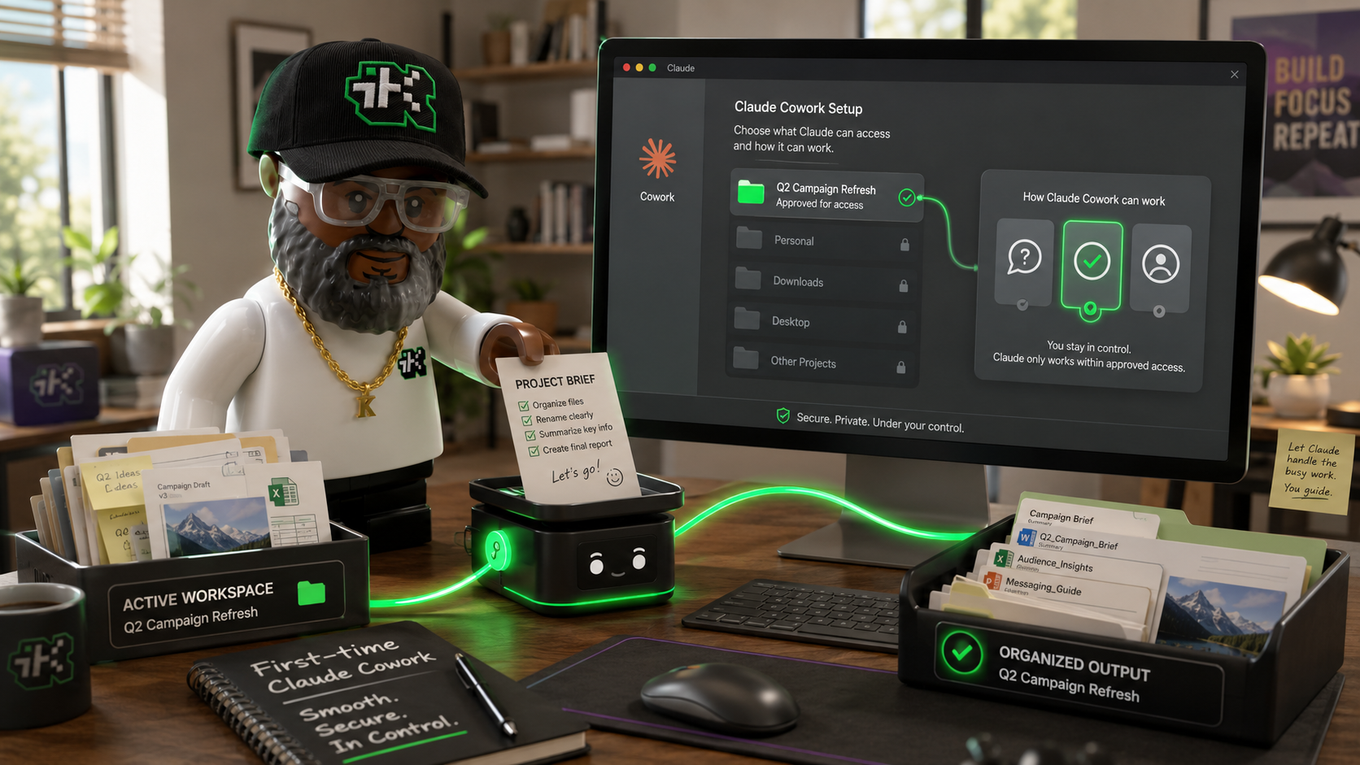

Cowork got scheduled tasks that run in the cloud without your desktop app open, and that one update is why this question keeps coming up. For a while, "runs on its own, on a schedule, connected to your other tools" was n8n's job description. Now Cowork can do a version of it too, so the two get compared like they're fighting for the same seat.
Cowork is a reasoning agent you hand a goal to in plain language. n8n is a workflow engine that runs a process you built, step by step, the same way every time. Judgment versus a fixed process is the core separation between the two. There's real overlap in how they end up getting used, but they stay different tools underneath it.
What Claude Cowork does
Claude Cowork is Anthropic's agentic mode inside the Claude app, agentic meaning it plans a sequence of steps and carries them out instead of waiting for you to spell out each one. It runs on the same underlying system as Claude Code, aimed at general work instead of a codebase: organizing a folder, building a spreadsheet with working formulas, turning a stack of meeting notes into a report, or researching a topic across a dozen sources and pulling it into one document.
You describe the outcome. Claude figures out the steps, reads and writes files in a folder you've connected, breaks the work into smaller pieces when it's complex, and hands back a finished document instead of instructions for making one. Sessions run in the cloud now, in beta, so a task keeps going after you close your laptop. When it needs something local, a file on your desktop, your browser, it reaches through the Claude Desktop app open on that machine.
Cowork is also easy to confuse with a Claude Project, which is a different, chat-based tool that never touches your computer at all. I broke down that distinction in Claude Projects vs. Cowork: What's the Difference?
Scheduled tasks are the newest piece: type /schedule in a task, and Cowork runs it again on a cadence you set, in the cloud, without your computer needing to be on. It's available on any paid Claude plan (Pro and up), through desktop, web, or mobile.
How much Cowork checks in with you before acting is its own setting. Manual mode pauses for your approval before anything real happens. Auto mode reviews each step for safety on its own and only stops you for the actions with real consequences: deleting a file, reaching outside a connected folder, or setting up a new scheduled task. Skip mode does neither, meant for a task you've already trusted enough to let run without interruptions.
I run this site through Cowork sessions connected to its folder. Describing what a page needs and letting Claude write the HTML, CSS, and JavaScript directly into place skips the drag-and-drop editor, the template license, and the separate site-builder subscription that usually stacks on top of hosting. I went deeper on how I built the site that way and what a first Cowork project looks like in their own posts.
What n8n does
n8n is a node-based workflow automation platform, a node being one step in a workflow (send an email, update a spreadsheet, call an API) that you connect to other nodes on a visual canvas. You build the flow once: a trigger starts it (a schedule, a form submission, a webhook, meaning a message an app sends automatically the instant something happens elsewhere, like a completed payment), and each node after that runs in a fixed order you defined.
n8n doesn't interpret an ambiguous request or decide what "organize this" should mean. You draw the branches, the conditions, and the fallback for every case yourself, once, and the same flow runs identically every time it fires, whether that's twice a day or ten thousand times a month. n8n lists more than 2,000 integrations it connects to directly, from Slack and Google Sheets to Airtable and GitHub, and you can drop JavaScript or Python into any step when a built-in node doesn't cover what you need.
Pricing splits the way it always has. The self-hosted Community Edition is free, unlimited executions, running on your own server. The hosted Cloud version starts around $20 to $24 a month for a Starter plan and scales up based on how many workflow runs you need. n8n raised $180 million in Series C funding at a $2.5 billion valuation in October 2025, a sign of how many businesses already run it as core infrastructure.
Self-hosting is also the reason compliance-heavy teams reach for n8n specifically: run your own instance and the data never leaves your infrastructure, which matters for anything under a real compliance requirement, health records, financial data, anything you can't hand to a third-party server. The Cloud plan trades that control for not having to run and patch your own instance.
If you want the bigger picture on what n8n is beyond node-and-trigger mechanics, I covered that in n8n: The Automation Tool That Doesn't Require a Computer Science Degree. And if you haven't touched n8n yet, I walked through building a first automation from a Google Form to a Slack notification, fifteen minutes, no code required to start.
Where the overlap looks bigger than it is
Cowork's scheduled tasks and n8n's triggers look like the same feature from a distance: something that runs later, on its own. The difference is what happens the moment it fires.
An n8n workflow executes a fixed sequence of nodes. No reasoning happens at runtime. The logic was already decided when you built it, which is exactly why it's predictable at scale: the same trigger produces the same result whether it's the first run or the ten-thousandth. A scheduled Cowork task, by contrast, re-reads its instructions and reasons through the steps again each time it runs. That's useful when the task involves judgment ("check these files and flag anything that looks off") and unnecessary overhead when it doesn't ("the moment this webhook fires, write this exact row to that exact sheet").
Each is built around a different kind of failure. n8n's execution logs, retries, and per-node debugging exist because a workflow needs to fail the same predictable way every time, which makes it easy to catch and fix once. A reasoning agent trades that predictability for the ability to handle a case no fixed rule accounted for, and it can also make a different call on two runs that look identical to you.
Two examples that make it clear
Same shape on the surface, different tool for each.
"Go through three years of scattered client PDFs, sort them by project, and build a summary spreadsheet." That's a Cowork job. It's a one-off, it needs judgment about which PDF goes where, and the value is in Claude reading the content itself and making calls a fixed rule set can't anticipate for every file.
"Every time a new row lands in Airtable, post it in the team Slack channel and copy it to a tracking sheet in Google Sheets." That's an n8n job. It runs constantly, unattended, triggered by something outside your control, and every run needs to do the exact same steps in the exact same order without you checking in.
Hand the first one to n8n and you're building conditional logic to approximate judgment a reasoning model already does natively. Hand the second one to Cowork and you're paying a reasoning agent to re-decide a decision that was never in question.
How the two work together
n8n's node library includes an Anthropic integration and an AI Agent node, meaning a workflow can call Claude directly to handle the one step that needs judgment, then hand the result back to the deterministic flow around it. I used exactly that setup in an AI feedback analyzer built in n8n with the Claude API. A webhook triggers the workflow, Claude reads the open-ended feedback and extracts themes, sentiment, and action items, a code node parses that into clean fields, and n8n writes the finished row to Google Sheets.
I landed on a rule of thumb in that build: if you can write it as a rule, don't pay AI to guess it. That's the same logic that separates Cowork from n8n at the larger scale, just applied one node at a time. n8n runs the reliable, repeating part. Claude handles the piece that needs judgment inside it.
Which one to reach for
If the job is a one-off, involves reading and understanding real content, and you'd rather describe what you want than design every step, that's Cowork. If it's already covered by your Claude plan, there's no separate bill for it.
If the job needs to run unattended, every time, triggered by something in another system, at a volume where you want logs and retries and predictability over judgment, that's n8n. Start with the free self-hosted version if you're comfortable running a server, or the Cloud plan if you'd rather not manage one.
Many people building real workflows end up needing both eventually. One answers what should happen. The other answers what should happen every single time.
Sources:
support.claude.com/en/articles/13345190-get-started-with-claude-cowork ·
n8n.io/pricing ·
n8n.io/integrations ·
blog.n8n.io/series-c